
Iran Publishes New Map Claiming Military Oversight Across Strategic Strait of Hormuz Zone

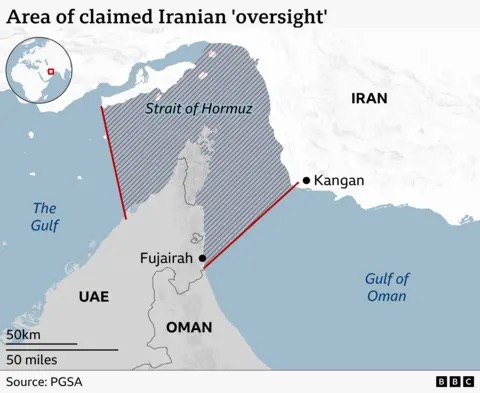
Iran’s Islamic Revolutionary Guard Corps (IRGC) has published a new map claiming military oversight over a large operational area surrounding the strategically vital Strait of Hormuz.
According to Iranian state-linked reports, the newly defined zone spans more than 22,000 square kilometers and significantly expands Tehran’s asserted military control over the waterway through which roughly one-fifth of the world’s oil and liquefied natural gas supply passes.
The map was released by the naval wing of the Islamic Revolutionary Guard Corps and outlines a broad “operational area” stretching between Iran’s southern coastline and parts of the United Arab Emirates coastline near Fujairah and Umm al-Quwain.
Iran Expanding Its Definition of Hormuz
Iranian military officials have stated that the Strait of Hormuz should no longer be viewed as a narrow shipping corridor, but rather as a much larger strategic military zone extending from Jask in eastern Iran to Siri Island in the west.
State-affiliated media reports claim the operational zone has expanded from a traditionally recognized 20–30 mile corridor into a much broader crescent-shaped area measuring nearly 200–300 miles in scope.
Iranian authorities also warned that vessels failing to comply with IRGC naval directives could face “serious risks” or interception.
Global Energy Markets Watching Closely
The Strait of Hormuz remains one of the world’s most strategically important maritime chokepoints.
Major oil exporters including:
- Saudi Arabia
- Iraq
- Qatar
- United Arab Emirates
depend heavily on the route for energy exports to global markets.
Any disruption or increased military tension in the region can significantly impact:
- Global oil prices
- Shipping insurance costs
- Energy supply chains
- International trade routes
Recent reports also indicate Iran has introduced tighter transit coordination measures for commercial vessels moving through the strait.
Growing Geopolitical Tensions
The move comes amid heightened tensions involving Iran, the United States, and Israel following recent regional military escalations.
Western governments and maritime security experts are closely monitoring Iran’s actions, with concerns that expanding military assertions around Hormuz could increase the risk of naval confrontations or shipping disruptions.
International maritime law traditionally guarantees transit rights through the Strait of Hormuz, making Iran’s expanded oversight claims potentially controversial on the global stage.
Despite the aggressive rhetoric, analysts say Iran’s strategy may also be aimed at strengthening deterrence and reinforcing its geopolitical leverage over one of the world’s most economically sensitive waterways.


