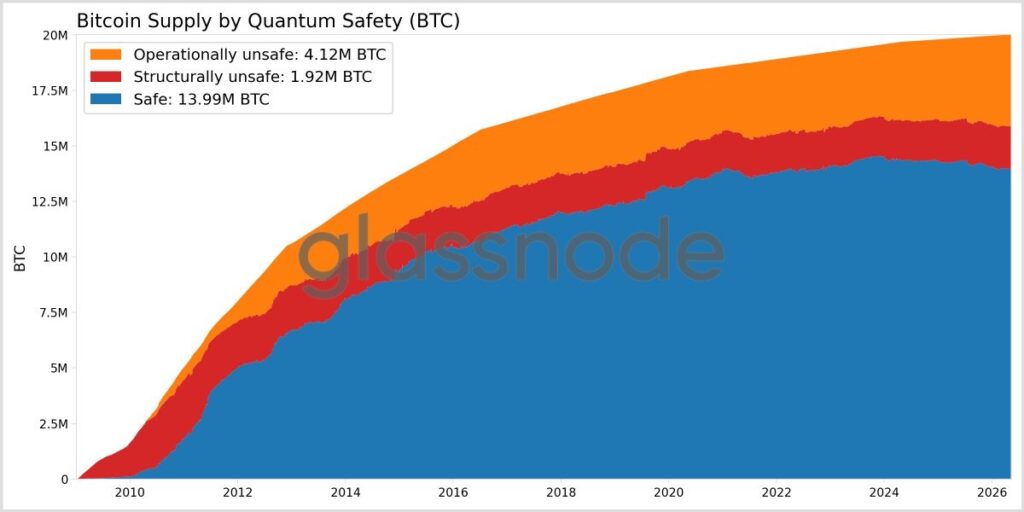

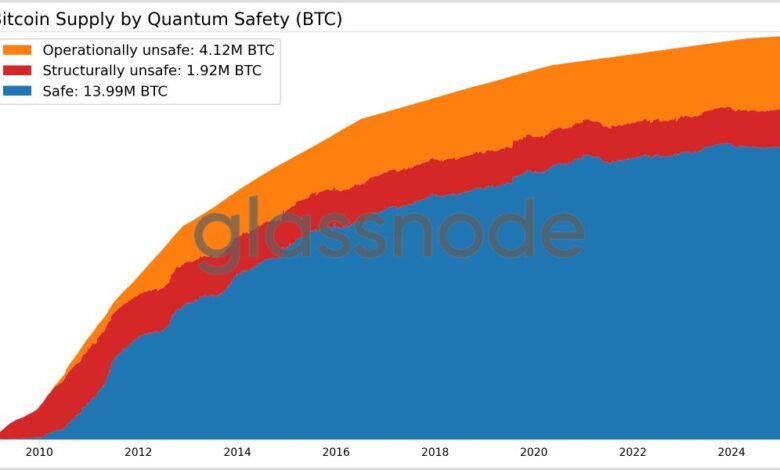
Glassnode has warned that a significant portion of Bitcoin’s circulating supply could eventually become vulnerable to quantum computing attacks if future quantum technology becomes powerful enough to break current cryptographic systems.
According to the firm, more than 6 million BTC — representing roughly 30% of Bitcoin’s total supply — already have public keys exposed on-chain, creating a potential long-term security concern for the network.
Based on current market prices, the exposed holdings are valued at nearly $500 billion.
Why Public Key Exposure Matters
Bitcoin uses public-key cryptography to secure wallets and transactions.
Under Bitcoin’s design:
- Wallet owners hold a private key
- Transactions reveal associated public keys once coins are spent
Current classical computers cannot realistically derive private keys from public keys because the cryptographic math is computationally infeasible.
However, sufficiently advanced quantum computers could theoretically use algorithms such as Shor’s Algorithm to break widely used elliptic curve cryptography systems much faster than traditional computers.
Which Bitcoin Is Most Vulnerable?
Security researchers say coins become more exposed once their public keys appear directly on the blockchain.
This includes:
- Reused Bitcoin addresses
- Older wallet formats
- Previously spent outputs
- Certain dormant wallets
Some analysts believe even early Bitcoin wallets potentially linked to Satoshi Nakamoto could eventually face theoretical quantum risks if the technology advances dramatically in future decades.
Quantum Threat Still Considered Long-Term
Most cybersecurity and cryptography experts emphasize that practical quantum attacks against Bitcoin are not currently possible.
Modern quantum computers still lack:
- Sufficient qubit scale
- Error correction stability
- Long-duration coherence
- Reliable cryptographic attack capability
Researchers estimate truly dangerous cryptographic-scale quantum systems may still be many years away.
However, the discussion is becoming increasingly important because:
- Quantum computing research is accelerating
- Governments are investing heavily in quantum technology
- Tech giants continue improving quantum hardware
- Financial systems globally rely on vulnerable cryptographic standards
Bitcoin Community Exploring Quantum Resistance
Developers and researchers within the Bitcoin ecosystem have already begun discussing future quantum-resistant upgrades.
Potential solutions could include:
- Quantum-safe cryptographic algorithms
- Wallet migration systems
- Soft fork or protocol upgrades
- New address standards
- Mandatory key rotation mechanisms
Some experts believe Bitcoin can eventually transition toward quantum-resistant cryptography before quantum attacks become realistically feasible.
However, implementing such changes across a decentralized global network would likely require massive coordination and long-term planning.
Wider Implications Beyond Bitcoin
The quantum computing threat extends far beyond cryptocurrencies.
Much of today’s digital infrastructure — including:
- Banking systems
- Government databases
- Internet encryption
- Military communications
- Cloud infrastructure
relies on cryptographic systems that future quantum computers may eventually weaken.
As a result, governments and technology companies worldwide are already investing in “post-quantum cryptography” research designed to secure systems against future quantum-era threats.
Glassnode’s warning highlights how the intersection of quantum computing and blockchain security is becoming one of the most important long-term discussions in the future of digital finance.